












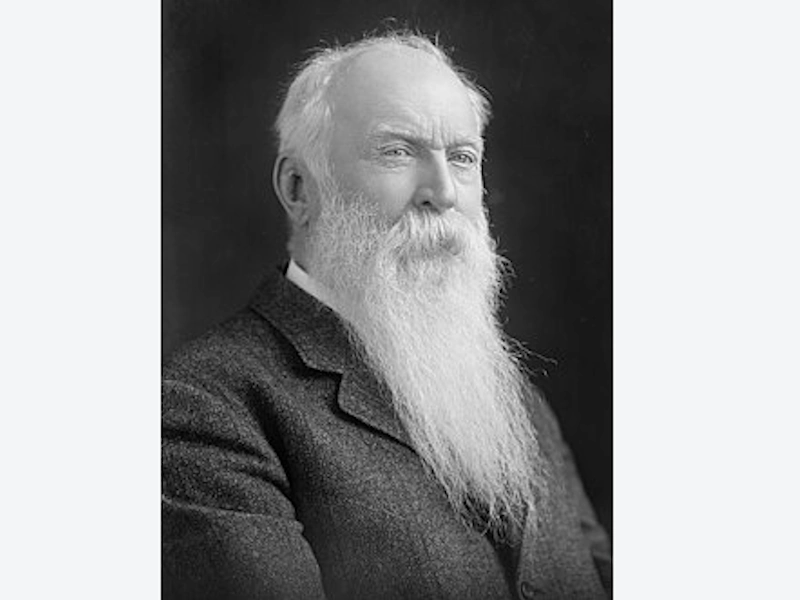
Most people have never heard of William Morris Stewart, yet his fingerprints are all over the American West. He helped shape the laws that governed mining claims, he was one of the first people to represent Nevada in the Senate, and he left a mark on a landmark constitutional amendment. His life reads like a tour through the most restless decades in American history.
An early life that pointed west
Stewart was born on August 9, 1827, in Galen, a small town in upstate New York. He studied at Yale for a time, but the lure of California’s gold fields pulled him away before he finished. Like thousands of other young men in 1850, he headed west hoping to strike it rich.
Mining did not make him wealthy. Law did. Stewart noticed quickly that miners were fighting constantly over who owned what, and that someone who understood the rules could make a living settling those fights. He studied law, built a practice in the mining towns of the Sierra foothills, and in 1854 briefly served as California’s attorney general.
Nevada and the Comstock Lode
When news of the Comstock Lode, an enormous silver discovery, spread in 1859, Stewart followed the crowds across the mountains. He settled in Virginia City and became one of the most sought-after lawyers in the territory. Claims on the Comstock overlapped, tunnels crossed beneath one another, and fortunes depended on court rulings. Stewart argued many of the biggest cases and earned a reputation as someone who could win them.
His legal work gave him standing, and that standing carried over into politics. He took part in the push for Nevada statehood and was involved in the constitutional convention that prepared the territory for admission to the Union in 1864.
Senator, then senator again
When Nevada joined the Union, the legislature sent Stewart to Washington as one of its first two senators. He served from 1864 to 1875, as a Republican, during Reconstruction. He then returned to the Senate in 1887 and stayed until 1905, which adds up to more than three decades in office across two separate stretches.
Two parts of his record stand out.
Mining law. Stewart was a leading author of the Mining Law of 1866, which gave miners on public land a legal path to claim and keep what they found. Later legislation in 1872 built on that foundation. Pieces of this framework still shape how mining on federal land works today.
The Fifteenth Amendment. Stewart took an active part in drafting the amendment that barred the government from denying the vote on the basis of race. Historians debate exactly how much of the final wording was his, and Stewart himself was quick to claim credit, but his involvement in the process is well documented.
Silver, and a complicated legacy
As the years went on, Stewart became one of the loudest voices for silver. Nevada’s economy depended on it, and he argued that making silver part of the nation’s currency would help ordinary borrowers and struggling farmers. In the early 1890s he broke with the Republican Party over the issue and aligned himself with the silver cause.
His record also contains chapters that look far less admirable today. He initially took a more moderate stance toward Chinese immigrants, but later backed restrictions on Chinese immigration, reflecting the hostility that was common in the West at the time. A fair portrait of Stewart has to hold both his lasting contributions and these failings.
A few interesting details
The writer Mark Twain, who knew Nevada well from his years there as a newspaperman, worked briefly as Stewart’s private secretary in Washington in the late 1860s.
Stewart is the namesake of the Stewart Indian School in Carson City, which he supported while in the Senate and which opened in 1890. The school’s history is now viewed with a great deal of scrutiny because of its role in federal assimilation policy.
In 1908 he published a memoir, which remains a useful, if self-flattering, window into frontier politics.
Death and remembrance
Stewart died on April 23, 1909, in Washington, D.C., at the age of 81. He had lived long enough to see Nevada move from a rough mining territory into a settled state.
mmWhy he still matters
Stewart is a reminder that the American West was built as much by lawyers and legislators as by prospectors. The rules he helped write decided who could dig, who could own, and who could vote. Whether you admire him, criticize him, or a bit of both, understanding his career helps explain how the West took the shape it has.