










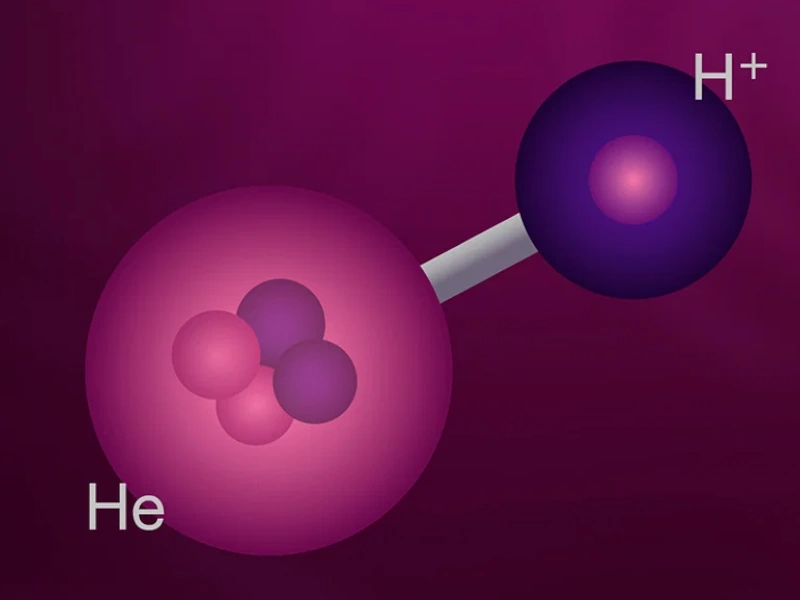
Long before stars, planets, or galaxies existed, the newborn universe was a hot, simple soup of fundamental particles slowly cooling enough to form the first atoms. Out of that early chemistry came the very first molecule ever to exist, a tiny, positively charged particle known as helonium. Despite its outsized cosmic significance, helonium remains largely unfamiliar outside of chemistry and astrophysics circles. This article explains exactly what helonium is, why it holds such a special place in the history of the universe, and where scientists have actually found it.
What Helonium Actually Is
Helonium is the common name for the helium hydride ion, with the chemical formula HeH⁺. It consists of a single helium atom bonded to a single hydrogen atom, with one electron removed, giving the resulting particle an overall positive charge. Because it carries this positive charge, helonium is classified as a cation, distinguishing it from the neutral, uncharged molecules most people are familiar with in everyday chemistry.
It’s worth being clear about what helonium is not: it is not a chemical element in its own right, and it does not appear anywhere on the periodic table. Rather, it is a molecular ion, a charged particle formed by combining two existing elements, helium and hydrogen, in a way that strips away one electron in the process. The name itself follows a naming convention, combining “helium” with the suffix “-onium,” a pattern also used for related ions like argonium.
Why Helonium Holds Such Cosmic Significance
Helonium is widely believed by scientists to be the very first molecule to have formed in the universe, emerging in the aftermath of the Big Bang as the young universe cooled enough for atoms to begin combining. Before helonium could form, conditions were simply too hot and chaotic for any stable chemical bonds to survive. Its formation marks, in a very real sense, the beginning of chemistry itself, the first step in a long chain of chemical processes that would eventually lead to the heavier elements, molecules, stars, and ultimately the conditions necessary for life.
This foundational role is what makes helonium such a significant subject for astrophysicists and chemists studying the universe’s earliest history, even though the ion itself is exceptionally simple compared to the complex molecules that would come much later.
Why Helonium Is So Rare and Hard to Study
Despite its historical importance, helonium is extraordinarily rare and difficult to observe or work with directly, for a very specific chemical reason: it is remarkably reactive. In fact, helonium is recognized as the strongest known acid, even stronger than fluoroantimonic acid, which is itself famous within chemistry for its extreme acidity. This intense reactivity means helonium cannot be prepared or stored in any meaningful quantity under normal laboratory conditions, since it will immediately react with virtually any other molecule it comes into contact with.
As a result, helonium exists almost exclusively under highly specific, energetic conditions, either in the vacuum of outer space, where there’s little else nearby for it to react with, or briefly, in carefully controlled laboratory environments designed specifically to produce and study it before it reacts away.
The History of Its Discovery
Helonium was first successfully produced in a laboratory setting in 1925, making it a surprisingly old discovery within the broader history of molecular chemistry. However, actually detecting it occurring naturally out in space proved to be a far greater challenge. Scientists had theorized since the 1970s that helonium should exist within the interstellar medium, based on their understanding of early universe chemistry, but confirming that theory observationally took decades longer.
That confirmation finally came in April 2019, when researchers detected helonium using the Stratospheric Observatory for Infrared Astronomy, known as SOFIA, an airborne telescope mounted aboard a modified aircraft. The detection was made within NGC 7027, a planetary nebula, the glowing shell of gas and dust cast off by a dying star, providing the first direct observational evidence confirming decades of theoretical prediction about where this foundational molecule could still be found in the present-day universe.
Physical Properties Worth Knowing
Unlike some other simple molecular ions, helonium has a permanent dipole moment, meaning it has an uneven distribution of electrical charge across the particle, with the calculated dipole moment measured at approximately 2.26 to 2.84 Debye units depending on the specific calculation method used. This property is scientifically useful because it makes the ion considerably easier to detect and study using spectroscopic techniques compared to molecules lacking this kind of charge asymmetry.
Within the ion itself, electron density is not evenly distributed between its two component atoms. Approximately 80 percent of the electron charge sits closer to the helium nucleus than to the hydrogen nucleus, reflecting helium’s stronger pull on the shared electron compared to hydrogen.
Common Misconceptions Worth Clearing Up
A few points of confusion come up repeatedly when people first encounter the term helonium. It is not a newly discovered chemical element, nor is it simply another name for ordinary, neutral helium gas. It is also distinct from neutral helium hydride; the “-ium” suffix and positive charge specifically indicate the cation form. And despite how the name might sound in casual conversation, helonium is not an internet slang term or abbreviation; within any scientific or educational context, the term refers specifically and consistently to the helium hydride ion.
A Curious Side Note
One website covering helonium includes an unusual, out-of-place statement describing “Helonium” as “a news website,” a claim that appears disconnected from the rest of that page’s otherwise accurate chemistry content. This kind of stray, mismatched sentence sometimes shows up in web content generated or compiled through automated processes, and it doesn’t appear to reflect any genuine, separate meaning of the term beyond the scientific one described throughout this article.
Final Thoughts
Helonium, the helium hydride ion with the chemical formula HeH⁺, holds a genuinely remarkable place in scientific history as the first molecule believed to have formed in the universe following the Big Bang. Though extraordinarily reactive and rare under normal conditions, its eventual confirmed detection in the planetary nebula NGC 7027 in 2019 closed a decades-long gap between theoretical prediction and observational evidence, cementing helonium’s role as a foundational piece of the universe’s earliest chemistry.