












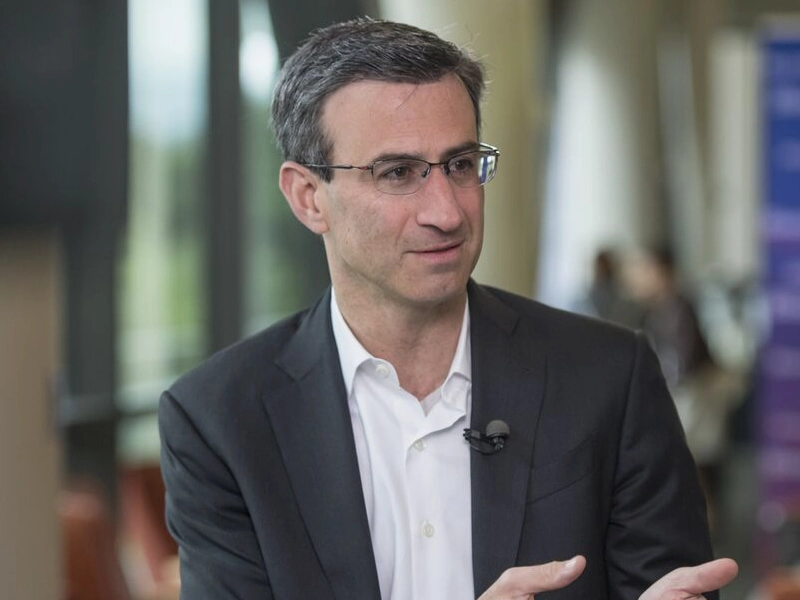
Few people have moved as seamlessly between the worlds of government economic policy and high finance as Peter Orszag. Over the course of a career spanning more than two decades, he has held two of the most consequential budget and fiscal policy positions in the United States government before rising to lead Lazard, one of the world’s most storied financial advisory and asset management firms.
This article traces his career from his early academic training through his government service and his current role atop Wall Street.
Early Life and Education
Peter Richard Orszag was born on December 16, 1968, in Boston, Massachusetts, and grew up in Lexington, Massachusetts, the son of a math professor. He went on to earn his economics degree from Princeton University, graduating summa cum laude, before being named a Marshall Scholar, a prestigious honor that funded his graduate studies in the United Kingdom.
He earned both a master’s degree and a PhD in economics from the London School of Economics, building the rigorous academic foundation that would later inform his work shaping some of the most significant fiscal and healthcare policy debates in modern American government.
Early Government Service Under Clinton
Orszag’s government career began during the Clinton administration, where he served on the White House Council of Economic Advisers and later as Special Assistant to the President for Economic Policy.
This early experience gave him direct exposure to the inner workings of federal economic policymaking at the highest level, setting the stage for the more senior roles he would take on in the years that followed.
Director of the Congressional Budget Office
In January 2007, Orszag was appointed Director of the Congressional Budget Office, a nonpartisan agency responsible for providing Congress with independent economic and budgetary analysis. During his tenure, which ran through November 2008, Orszag notably expanded the CBO’s focus to place greater emphasis on healthcare costs and climate change, two areas that would come to dominate national policy debates in the years ahead.
He brought on additional health policy analysts specifically to prepare Congress for the healthcare reform discussions that were beginning to take shape, work that would prove directly relevant to his next major government role.
Director of the Office of Management and Budget
Following Barack Obama’s election, President-elect Obama selected Orszag to serve as Director of the Office of Management and Budget, a position he held from January 2009 to July 2010, making him the 37th person to hold that role.
As OMB Director, Orszag played a central role in shaping the Obama administration’s early fiscal agenda, including significant involvement in crafting the Affordable Care Act, drawing directly on the healthcare policy expertise he had built during his time at the CBO.
Transition to the Private Sector
After leaving the Obama administration in 2010, Orszag moved into the private sector, joining Citigroup before eventually making his way to Lazard in 2016. At Lazard, he built his career within the firm’s financial advisory business, eventually being named CEO of Lazard’s Financial Advisory division in April 2019, a role in which he oversaw the firm’s core investment banking and advisory operations.
Becoming CEO of Lazard
Orszag’s rise at Lazard culminated in May 2023, when the firm’s board unanimously elected him to become the company’s next Chief Executive Officer, succeeding longtime CEO Kenneth Jacobs, who transitioned to the role of executive chairman.
Orszag officially assumed the CEO position on October 1, 2023. In announcing the transition, Lazard’s leadership praised Orszag as a strategic, visionary, and decisive leader with deep relationships across the financial industry.
His responsibilities expanded further on January 1, 2025, when he took on the additional title of Chairman of Lazard’s Board of Directors, giving him oversight of both the firm’s global strategy and its board-level governance.
Leading Lazard Today
As CEO and Chairman, Orszag now oversees Lazard’s full global business, spanning both its financial advisory operations and its asset management arm. He has articulated an ambitious growth vision for the firm, publicly stating his aim to double Lazard’s revenue by 2030 as part of a long-term strategic plan the firm has referred to internally as Lazard 2030.
As part of that growth strategy, he announced plans in late 2023 to expand the firm’s roster of managing directors by approximately ten per year, reflecting a deliberate push to scale the firm’s advisory capacity and competitive position within the global financial industry.
Continued Public and Academic Involvement
Beyond his role at Lazard, Orszag has remained actively engaged in public policy, healthcare, and academic circles. He is a member of the National Academy of Medicine, part of the National Academies of Sciences, reflecting his sustained involvement in healthcare policy well beyond his government tenure.
He continues to serve on and advise various organizations connected to economics, healthcare policy, and education, drawing on the depth of expertise he built across his government career.
A Career Defined by an Unusual Combination
What makes Peter Orszag’s career particularly notable within both Washington and Wall Street circles is the rarity of his specific combination of experience: deep, hands-on involvement at the highest levels of federal fiscal and healthcare policy, paired with a successful rise to the top of one of the financial industry’s most historically significant firms.
Few executives bring this particular blend of government policymaking credibility and financial industry leadership to a major Wall Street CEO role, making his career trajectory a frequently cited example of the sometimes-overlapping paths between public service and private finance at the highest levels.
Final Thoughts
Peter Orszag’s career reflects a sustained thread of fiscal and economic expertise applied across remarkably different settings, from shaping healthcare and budget policy at the Congressional Budget Office and the Office of Management and Budget, to now leading the global strategy of one of the world’s most prominent financial advisory firms as CEO and Chairman of Lazard.
His path from Marshall Scholar and academic economist to two of Washington’s most significant budget roles, and ultimately to the top of Wall Street, stands as a distinctive example of a career built on deep, applied economic expertise carried across both public service and private industry.