













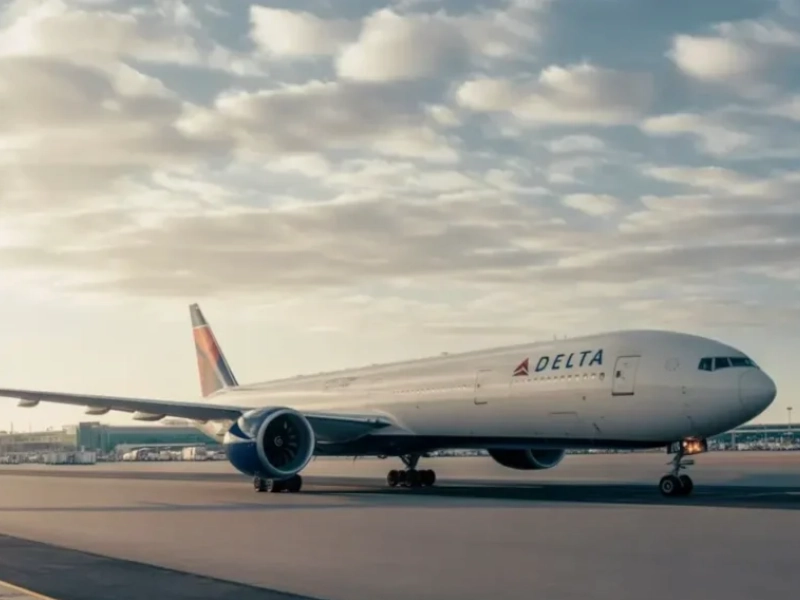
When a long haul international flight suddenly reverses course mid journey, it tends to attract attention quickly, both from passengers directly affected and from aviation trackers monitoring flight activity in real time. That was the case with Delta Air Lines flight DL275, which departed Detroit bound for Tokyo Haneda Airport before turning around over the Bering Sea and diverting to Los Angeles International Airport, commonly known as LAX.
This article breaks down what is confirmed about the Delta flight DL275 diversion to LAX based on verified flight tracking data, and separates that from the inconsistent, unconfirmed explanations circulating elsewhere online about why the diversion actually occurred.
The Confirmed Flight Details
According to real time flight tracking data, Delta flight DL275 departed from Detroit Metropolitan Wayne County Airport on a scheduled route to Tokyo Haneda Airport. The aircraft operating the flight was an Airbus A350-900, registered with tail number N508DN, a widebody jet typically used by Delta for long haul international routes given its extended range capability.
While flying over the Bering Sea, well into the transpacific portion of the journey, the flight crew made the decision to turn the aircraft around rather than continue on to Tokyo. From that point, the aircraft flew for approximately five hours back across the Pacific before landing at LAX, touching down on runway 06R in the early morning hours local time. This sequence of events, the departure, the turnaround point, the aircraft type, and the eventual landing at LAX, is documented through independent flight tracking records rather than secondhand reporting, making it the most reliable foundation for understanding what actually happened.
Why the Exact Cause Remains Unclear
One important detail often missing from casual coverage of this event is that the specific reason behind the diversion was not clearly confirmed in the flight tracking data itself. Independent aviation tracking sources that documented the flight’s movement in real time noted that the reason for the turnaround was undetermined at the time of reporting, rather than attributing it to any single, specific cause.
This distinction matters because several other accounts of the DL275 diversion that have circulated online describe very different, and notably contradictory, explanations for what occurred. Some accounts attribute the diversion to a technical issue involving an engine anti-ice system, describing a specific mechanical failure scenario in detail. Other accounts describe an entirely different situation involving a disruptive passenger who was met by law enforcement upon landing. These two explanations are not simply different levels of detail about the same event, they describe fundamentally different routes, different circumstances, and different sequences of events, which raises significant doubt about the accuracy of either specific narrative.
Given this inconsistency, and the absence of a single, clearly sourced official explanation, readers should treat any specific claimed cause for the DL275 diversion with appropriate caution unless it can be traced to an official statement from Delta Air Lines or a verified aviation safety authority.
Why Flights Divert in the First Place
Regardless of the specific cause behind this particular flight, understanding the general reasons airlines divert flights helps provide useful context. Diversions are a normal, if relatively uncommon, part of commercial aviation operations, and airlines train flight crews extensively to handle them safely and efficiently.
Mechanical or technical issues are among the most common reasons for a diversion. Modern aircraft are equipped with extensive monitoring systems that alert crews to potential issues, and pilots are trained to prioritize caution, often choosing to divert and land safely rather than continuing to a distant destination when any system shows signs of malfunction.
Medical emergencies involving passengers or crew members can also prompt a diversion, particularly on long haul international flights where reaching definitive medical care quickly may not otherwise be possible.
Passenger behavior issues occasionally lead to diversions as well, when a disruptive or unsafe situation onboard requires law enforcement intervention that cannot wait until the original destination.
Weather conditions, including severe storms or hazardous conditions at the planned destination, can also force a flight to alter course, particularly on long transoceanic routes where conditions can change significantly over the course of a multi hour flight.
Without a confirmed, specific explanation for DL275, any of these general categories remains a plausible possibility, though none should be presented as a confirmed fact without proper sourcing.
Why LAX Was a Logical Diversion Point
Regardless of the underlying cause, Los Angeles International Airport represents a logical choice for a flight originating on the West Coast bound transpacific route to divert to. LAX functions as one of Delta’s major hub airports, meaning the airline maintains significant ground infrastructure, staffing, and operational support there. This includes the ability to rebook affected passengers efficiently, given the airport’s frequent connections to Asian destinations including Tokyo, as well as access to maintenance resources appropriate for widebody aircraft like the Airbus A350.
Airports selected for flight diversions are generally chosen based on a combination of factors, including runway length suitable for the aircraft type, available emergency services, weather conditions at the time, and the airline’s own operational presence at that location. LAX satisfies each of these considerations for a Delta operated widebody aircraft, which helps explain why it served as the diversion point rather than returning fully to Detroit or continuing toward an alternate Asian airport.
What Happened to Affected Passengers
While specific passenger experience details from this particular flight have not been independently confirmed through verified sourcing, general industry practice following a diversion typically involves the airline providing updated flight information, arranging ground accommodations if an extended delay is expected, and rebooking passengers onto subsequent flights toward their original destination. Given LAX’s frequent flight schedule to Tokyo, affected passengers on DL275 would likely have had multiple rebooking options available compared to a diversion at a smaller, less connected airport.
The Broader Lesson in Verifying Flight Incident Reports
The DL275 diversion serves as a useful reminder of how quickly incomplete information can multiply once a notable aviation event begins circulating online. A real, verifiable flight diversion, confirmed through legitimate tracking data, can end up surrounded by multiple competing, unverified explanations, each presented with confident, specific sounding detail. For travelers, aviation enthusiasts, or anyone researching a specific flight incident, the most reliable approach is to prioritize information traceable to official airline statements, aviation safety authorities, or independent flight tracking data, rather than secondary accounts that may fill in missing details with speculation presented as fact.
Final Thoughts
Delta flight DL275 did divert from its planned Detroit to Tokyo route to Los Angeles International Airport in late May 2025, a fact well supported by independent flight tracking data documenting the aircraft’s actual movement. However, the specific reason behind that diversion remains unconfirmed based on available reliable sourcing, despite several conflicting explanations circulating elsewhere online. Readers interested in the full, confirmed details behind this event are best served by seeking an official statement from Delta Air Lines directly, rather than relying on secondary accounts that offer specific but unverified and contradictory explanations for what actually occurred.