












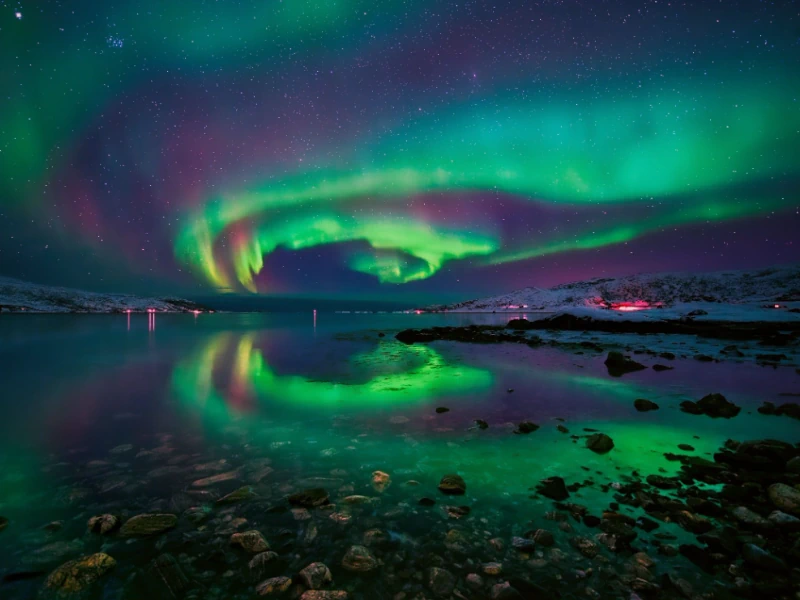
Few natural phenomena capture human imagination quite like the Northern Lights. Known scientifically as the aurora borealis, this shifting curtain of green, purple, and red light has fascinated people for thousands of years, inspiring myths, guiding early navigators, and today drawing travelers from around the world to remote, dark skies in pursuit of a single unforgettable sighting. Understanding what actually causes this glowing display, where and when it can be seen, and the rich cultural history surrounding it adds a deeper layer of appreciation to an already breathtaking experience.
This article explores the science behind the aurora borealis, the best conditions and locations for viewing it, and the cultural traditions that have grown up around this remarkable natural light show.
What Causes the Northern Lights
The aurora borealis begins with the sun. The sun constantly releases a stream of charged particles known as the solar wind, along with occasional larger bursts of energy called coronal mass ejections. When these charged particles travel through space and reach Earth, most are deflected by the planet’s magnetic field. However, near the magnetic poles, the field lines funnel some of these particles down into the upper atmosphere.
As these charged particles collide with gas molecules in the atmosphere, primarily oxygen and nitrogen, they transfer energy to those molecules. This energy excites the electrons within the gas atoms, and as those electrons return to their normal state, they release the energy in the form of light. This process, fundamentally similar to how a neon sign produces light through gas excitation, is what produces the vivid, shifting colors of the aurora.
Why the Aurora Shows Different Colors
The specific colors visible during an aurora display depend largely on which gas molecules are involved and at what altitude the collisions occur. Oxygen molecules are responsible for the most commonly seen green auroras, typically produced at altitudes between about 100 and 300 kilometers above the Earth’s surface. At higher altitudes, oxygen can also produce a rarer red glow. Nitrogen molecules tend to produce blue and purple hues, often appearing along the lower edges of an aurora display or mixing with green to create more complex color patterns.
The intensity and color variation of a given aurora display depends on factors including the strength of the incoming solar particles, the altitude at which collisions occur, and the overall geomagnetic activity at the time, which is why no two aurora displays ever look exactly identical.
The Role of Earth’s Magnetic Field
Earth’s magnetic field plays a critical role in both enabling and shaping the aurora. This field extends far beyond the planet’s surface, forming a protective structure known as the magnetosphere that shields Earth from much of the direct impact of solar wind. Near the magnetic poles, however, the field lines dip down toward the surface, creating natural funnels that guide charged particles into the atmosphere in roughly oval shaped zones surrounding the northern and southern magnetic poles.
This is why auroras are typically visible only at high latitudes under normal conditions, appearing in a band commonly referred to as the auroral oval. During periods of intense solar activity, this oval can expand significantly, occasionally making the aurora visible at much lower latitudes than usual, a phenomenon that has led to rare, widely reported sightings far outside the typical polar regions during major geomagnetic storms.
Best Locations for Viewing the Aurora
Certain regions of the world are consistently well positioned for aurora viewing due to their proximity to the northern auroral oval. Northern Norway, Sweden, and Finland, particularly areas above the Arctic Circle, are among the most popular and accessible destinations for aurora tourism. Iceland offers similarly strong viewing opportunities, combined with dramatic volcanic and glacial landscapes that make for striking photography backdrops. Parts of Canada, particularly the Yukon and Northwest Territories, along with Alaska in the United States, also provide excellent viewing conditions given their high latitude positioning and relatively low light pollution in many areas.
Within the southern hemisphere, the equivalent phenomenon, known as the aurora australis or Southern Lights, can be observed from far southern locations including parts of New Zealand, Tasmania, and Antarctica, though these viewing opportunities tend to be less accessible for most travelers compared to northern hemisphere locations.
Best Conditions for Seeing the Aurora
Successfully viewing the Northern Lights depends on a combination of factors beyond simply being in the right geographic region. Darkness is essential, meaning viewing is generally limited to the months surrounding the winter season in high latitude regions, when nights are long enough to provide extended periods of darkness. Clear skies free of cloud cover are equally important, since even strong auroral activity remains invisible behind heavy clouds.
Solar activity levels also play a significant role. The sun follows an approximately eleven year cycle of increasing and decreasing activity, and aurora visibility tends to be more frequent and more intense during periods closer to what is known as solar maximum, when sunspot activity and solar flares occur more often. Many aurora chasers monitor space weather forecasts and geomagnetic activity indexes to help predict favorable viewing nights, since even within the right location and season, aurora activity can vary significantly from one night to the next.
Cultural History and Folklore
Long before scientists understood the physics behind the aurora borealis, cultures across the Arctic and subarctic world developed rich traditions and folklore to explain the mysterious lights appearing in their night skies. In Norse mythology, the lights were sometimes associated with the Bifrost, a glowing bridge connecting the world of humans to the realm of the gods. Among various Indigenous peoples across the Arctic regions of North America, interpretations varied widely, with some traditions viewing the lights as the spirits of ancestors, while others associated them with the spirits of animals or interpreted them as omens tied to significant life events.
In Finnish folklore, the aurora is traditionally referred to as revontulet, meaning fox fires, tied to a legend describing a mythical fox running across the snow so quickly that its tail sent sparks flying into the sky. These varied cultural interpretations reflect just how universally captivating this phenomenon has been across human history, inspiring meaning and storytelling long before the underlying solar and atmospheric science was understood.
The Aurora’s Role in Modern Science and Space Weather
Beyond their visual beauty, auroras serve an important scientific purpose today, offering a visible indicator of broader space weather activity. Strong geomagnetic storms capable of producing intense, widespread auroral displays can also pose risks to modern technology, including satellite operations, power grid stability, and radio communications. Scientists and space agencies actively monitor solar activity and geomagnetic conditions in part to help predict and prepare for these potential disruptions, making the aurora not just a stunning natural spectacle, but also a visible signal of the sun’s ongoing influence on our planet’s technological infrastructure.
Final Thoughts
The Northern Lights represent a remarkable intersection of astrophysics, atmospheric science, and centuries of human wonder and storytelling. From the solar particles that begin their journey millions of miles away to the excited atmospheric molecules that finally produce those unmistakable curtains of color, the aurora borealis offers a powerful reminder of the dynamic relationship between our planet and the sun. Whether experienced through the lens of modern science or through the rich folklore passed down across generations of Arctic cultures, the Northern Lights remain one of the most awe inspiring natural phenomena visible from Earth.