











Plenty of students walk out of their first geometry class thinking it’s a subject about memorizing formulas. That impression is understandable, and it is also wrong. Geometry is really about seeing, and then explaining what you see. Once that clicks, the formulas stop feeling like arbitrary rules and start feeling like conclusions you could have reached yourself.
This guide lays out a practical, third-generation approach to learning geometry: less cramming, more noticing.
Start with what you can see
Before any definition, look around. A door is a rectangle. A pizza slice is a triangle with a curved edge. A bicycle wheel is a circle held together by straight lines. Geometry begins with this simple habit of spotting shape in the world.
A good first exercise is to collect ten everyday objects and describe each one using only the language of geometry: how many sides, what kinds of angles, whether any parts are parallel. You will build vocabulary without ever opening a textbook.
Learn the building blocks in the right order
Geometry is a ladder, and skipping rungs is the main reason people fall off. A sensible order looks like this:
- Points, lines, and planes. These are the raw materials.
- Angles. Learn how they are measured and named, and how they behave when lines cross.
- Triangles. The most important shape in the subject, because nearly every other polygon can be broken into triangles.
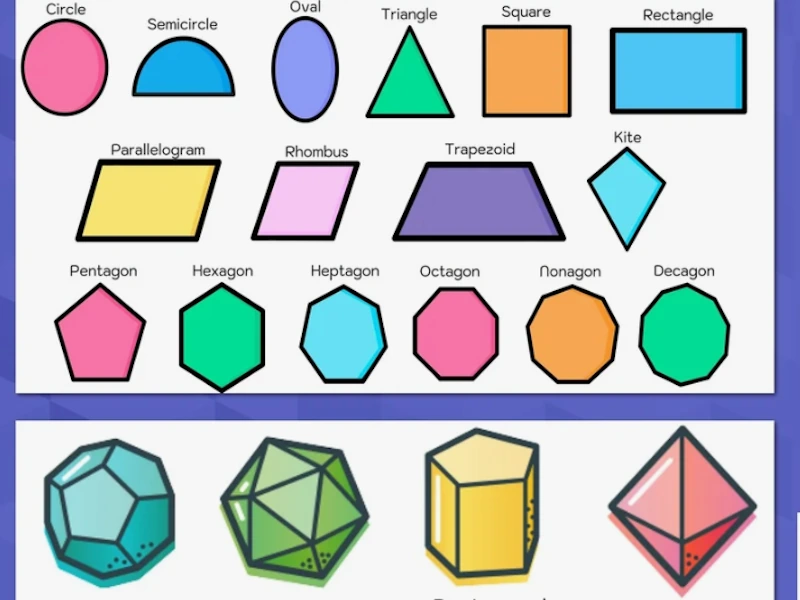
- Quadrilaterals and other polygons. Squares, rectangles, parallelograms, and trapezoids all become easier once triangles feel comfortable.
- Circles. Radius, diameter, chords, arcs, and tangents.
- Solids. Prisms, cylinders, cones, and spheres, along with surface area and volume.
Spend extra time on step three. Students who understand triangles deeply tend to find everything after it far less intimidating.
Draw everything
If there is one piece of advice worth repeating, it is this: never solve a geometry problem without a sketch. A diagram turns an abstract sentence into something your eyes can work with. Draw it large, label every given measurement, and mark equal sides and angles with small tick marks or arcs.
Many students discover that the answer was hiding in the drawing all along. A line that looked unrelated suddenly turns out to be parallel to another, or two triangles reveal themselves to be the same shape in different sizes.
Understand formulas instead of memorizing them
Take the area of a triangle, which is one half of the base times the height. Instead of storing that as a fact, picture a rectangle with the same base and height. Draw a diagonal across it. You have just cut the rectangle into two identical triangles, so each must be half the rectangle. The formula now has a reason behind it, and reasons are much harder to forget than rules.
Try the same trick elsewhere. The area of a parallelogram can be rearranged into a rectangle. The circumference of a circle is tied to its diameter by the number pi, which you can discover for yourself by wrapping string around a few different round objects and measuring.
Make peace with proofs
Proofs are where many learners lose confidence, so it helps to reframe them. A proof is simply a chain of explanations, each step justified by something already known. Think of it as telling a very careful story.
A few habits make proofs easier:
- Write down what you are given and what you need to show before doing anything else.
- Look for familiar patterns, such as vertical angles, shared sides, or parallel lines cut by a transversal.
- Work backward from the goal when you feel stuck, asking what would have to be true for the conclusion to hold.
- Check that every step has a reason attached.
- Use tools, but keep your hands involved
Dynamic geometry software lets you drag a vertex and watch an entire figure respond, which is a wonderful way to test whether a pattern always holds. Still, keep a ruler, compass, and protractor nearby. Constructing a perpendicular bisector by hand teaches you something that clicking a button never will.
Practice with purpose
Short, regular sessions beat long, rare ones. Aim for twenty or thirty minutes a few times each week. After each problem, ask yourself two questions: what was the key idea, and where else might it apply? Keep a small notebook of these key ideas, and review it before tests.
Where geometry shows up later
Geometry is not a closed chapter once the exam is over. Architects rely on it to design stable buildings. Game developers use it to place characters in three dimensional worlds. Surveyors, graphic designers, tailors, and carpenters use it daily. Even basic skills like estimating whether a couch will fit through a doorway come from spatial reasoning you sharpen here.
Final thoughts
Learning geometry well comes down to patience, curiosity, and a pencil. Look for shapes in the world, draw every problem, understand why formulas work, and treat proofs as stories. Do that consistently, and the subject becomes one of the most satisfying parts of mathematics.