













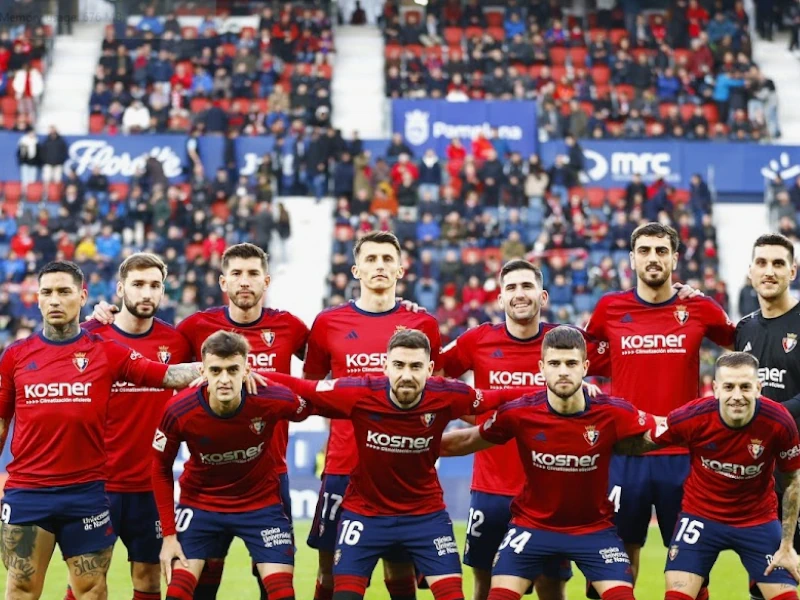
Club Atlético Osasuna occupies a distinctive place within Spanish football, a club whose very name, meaning “health” in the Basque language, reflects its deep roots in the regional identity of Navarre. Based in Pamplona and playing its home matches at the distinctive El Sadar Stadium, Osasuna has built a reputation over more than a century as a resilient, fiercely regional club with a history shaped by both sporting triumph and genuine historical hardship.
The Founding of the Club
Osasuna’s origins trace back to a merger between two rival Pamplona football clubs, Unión Sportiva and New Club, which had emerged from a split within an earlier organization known as Sociedad Sportiva. Rather than allowing the sport to fragment or disappear from the region following internal disagreements, representatives from both clubs, including Eduardo Aizpún, Francisco Altadill, and Gerardo Arteaga from Sociedad Sportiva, and Joaquín Rasero, Augusto Vizcarra, and Ángel Goikoetxea from New Club, came together and agreed to form a unified new club.
The founding assembly took place on October 24, 1920, where the name Osasuna was formally approved by vote, a deliberate departure from the era’s common practice of naming football clubs using English terms. Alongside the new name came the decision to wear red as the club’s color, a symbolic tribute to the flag of Navarre that rooted the club’s identity firmly in its home region from the very beginning. That same afternoon, Osasuna played its first-ever match, a 1-1 draw against the Regimiento de la Constitución, a local military unit, at the Ensanche field. The club’s full name, Club Atlético Osasuna, appeared officially for the first time in January 1921, and its now-familiar crest, featuring red, blue, a lion, and a crown, was unveiled in 1922.
Early Development and Rise Through the Divisions
Osasuna’s early growth was rapid by the standards of the era. Just five years after its founding, the club fielded its first-ever international player, Seve Goiburu, who remained with the team until the 1928-29 season. When Spanish football adopted a formal divisional structure, Osasuna found itself initially placed in the third tier before working its way up the pyramid, gaining promotion to the Segunda División after winning a promotion playoff following the 1931-32 season. Osasuna reached Spain’s top flight, La Liga, for the first time just three seasons later, in the mid-1930s, and made an immediate impression by reaching consecutive Copa del Rey semi-finals.
The Spanish Civil War and a Period of Hardship
Osasuna’s early progress was brutally interrupted by the Spanish Civil War, a period during which the club suffered severe repression, with players and club officials persecuted, and in tragic cases, killed. This dark chapter stands as one of the most significant and sobering parts of the club’s history, a stark reminder of how deeply the broader turmoil of the era affected institutions far beyond the political sphere. When football resumed following the war, Osasuna was controversially offered a place in La Liga, but the club struggled to establish itself and spent many subsequent years outside the top division as it worked to rebuild.
Stability and the Opening of El Sadar
Osasuna’s fortunes gradually stabilized through the 1950s, as the club re-emerged in La Liga and managed to sustain its top-flight status across several seasons. A major milestone in the club’s history came in 1967 with the opening of El Sadar Stadium, which gave Osasuna a permanent home ground that would go on to become one of the most distinctive and atmospheric venues in Spanish football, known for its passionate crowd and unique architectural character.
Growth Through the 1980s and 1990s
Osasuna’s competitive standing continued to grow through the 1980s and into the early 1990s. The club achieved its first European qualification in the 1985-86 season, and delivered a historic fourth-place league finish in 1990-91, a result that earned the club a strong run in the UEFA Cup that followed. This period represented one of the more competitively significant eras in the club’s modern history, though it was followed by relegation in the mid-1990s, ushering in a prolonged stretch in the Segunda División.
The Early 2000s Golden Era
The early 2000s marked one of the strongest periods in Osasuna’s entire history. Following promotion back to La Liga in 2000, the club delivered a string of consistent top-flight performances, reaching the Copa del Rey final in 2005 and following that with a remarkable fourth-place finish in the 2005-06 La Liga season, a result strong enough to earn the club qualification for the Champions League qualifying rounds. Although Osasuna narrowly missed out on reaching the Champions League group stage itself, the club channeled that momentum into an outstanding run in the 2006-07 UEFA Cup, advancing all the way to the semi-finals, a genuine high-water mark for a club of Osasuna’s traditional size and resources within Spanish football.
Osasuna Today
Osasuna remains a fixture of Spanish football, continuing to compete in La Liga under the leadership of president Luis Sabalza. The club continues to play its home matches at El Sadar, now with a capacity of 23,516, and retains its well-known nicknames, Los Rojillos, or “The Little Reds,” and the Basque nickname Gorritxoak. Like many Basque and Navarrese clubs, Osasuna has consistently placed a strong emphasis on developing homegrown talent through its cantera, or youth academy system, reflecting a broader regional football culture that prioritizes local player development alongside first-team competitiveness.
Beyond the men’s first team, the club also maintains an active reserve side, Osasuna B, along with Osasuna Femenino, the club’s women’s football section, which currently competes in the Primera Federación, reflecting the club’s continued growth and investment across multiple levels and formats of the sport.
A Club Defined by Regional Identity
What distinguishes Osasuna from many of Spanish football’s larger, more commercially dominant clubs is the depth of its connection to its home region. From its Basque-language name meaning health, to its red kit honoring the flag of Navarre, to the enduring emphasis on cantera-developed talent, Osasuna has maintained a consistent sense of place and identity throughout more than a century of football, weathering periods of serious hardship and enjoying periods of genuine competitive success along the way.
Final Thoughts
Club Atlético Osasuna’s story reflects the broader arc of Spanish football itself, shaped by early twentieth-century growth, the devastating disruption of civil war, and a slow, determined rebuilding process that eventually produced some of the club’s proudest competitive moments in the mid-2000s. Grounded firmly in the identity and pride of Navarre, and anchored by the distinctive atmosphere of El Sadar Stadium, Osasuna continues to represent one of Spanish football’s most regionally significant and historically resilient clubs.