











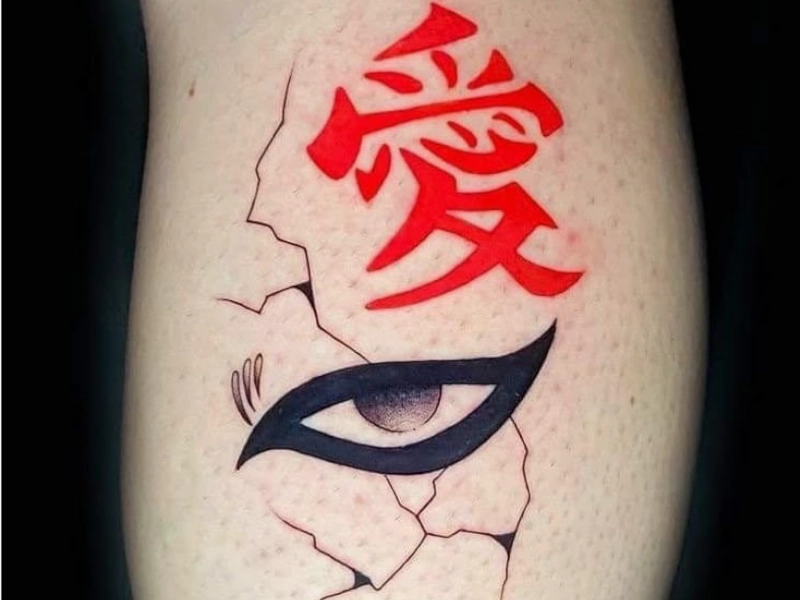
Few anime characters have inspired as much dedicated tattoo art as Gaara, the Fifth Kazekage of the Hidden Sand Village from Masashi Kishimoto’s Naruto series. At the center of nearly every Gaara tattoo is a single, deceptively simple design element, the kanji character for “love” that Gaara carved into his own forehead as a child.
Behind that small symbol lies one of the most emotionally layered character arcs in the entire series, which is exactly why it has become such a popular and meaningful choice for tattoo enthusiasts and Naruto fans alike.
This guide covers the meaning behind Gaara’s iconic tattoo, the character’s backstory that gives it its emotional weight, and popular design approaches for anyone considering a Gaara inspired tattoo of their own.
Who Gaara Is
Gaara is introduced in Naruto as a shinobi from Sunagakure, the Hidden Sand Village, and one of the series’ most compelling antagonists turned allies. He was born as the jinchūriki, or human vessel, for Shukaku, the One-Tailed Beast, a burden placed on him before birth by his own father in an attempt to strengthen the village’s military power.
Gaara’s mother died during his birth, and the villagers around him, including at times his own family, treated him with fear and isolation because of the destructive tailed beast sealed within him.
This early rejection shaped Gaara into a cold, violence driven character during his first appearances in the series, someone who genuinely believed love was something he could never receive from others.
The Origin of the Kanji Tattoo
Gaara’s forehead tattoo is the kanji character 愛, meaning “love,” which he carved into his own skin using his sand manipulation abilities following a failed assassination attempt ordered against him as a child. At the time, the tattoo represented something considerably darker than its literal translation suggests.
Believing that the only love he would ever know was self-love, born purely out of survival and self-preservation, Gaara adopted the mark as a declaration that he existed for himself alone, a shield against a world that had shown him nothing but fear and rejection.
This origin is central to understanding why the tattoo carries so much more weight than a simple decorative symbol. It began as a mark of isolation and a hardened, self-protective worldview, not as an expression of warmth or connection.
How the Meaning Transforms Over the Series
What makes Gaara’s tattoo so resonant with fans is how its meaning evolves alongside his character. His confrontation and subsequent friendship with Naruto Uzumaki, another jinchūriki who experienced similar childhood isolation but chose a fundamentally different path, becomes the turning point in Gaara’s worldview. Through this relationship, Gaara begins to understand genuine connection and compassion for the first time.
Later in the series, Gaara also learns that the sand which had always instinctively protected him throughout his life was tied to his mother’s love, reframing his understanding of his own painful origin story.
By the time Gaara becomes the Fifth Kazekage, a respected and deeply compassionate leader of his village, the tattoo has been fully recontextualized. It no longer represents isolation and self-preservation, but rather the full arc of his transformation, from a child who believed he could only love himself to a leader capable of genuine care, loyalty, and connection with others.
This evolution, from a mark of pain to a symbol of hard-won growth, is precisely why so many fans connect with the tattoo on a personal level, often relating it to their own journeys through difficult circumstances toward healing and self-acceptance.
Popular Gaara Tattoo Design Approaches
For anyone considering a Gaara inspired tattoo, there are several common approaches fans tend to take, each emphasizing a different aspect of the character.
The kanji symbol alone. The most direct and widely chosen option is a minimalist rendering of the 愛 kanji itself, often placed on the forehead to directly mirror Gaara’s own design, though many fans choose more discreet placements like the wrist, forearm, or shoulder for a subtler nod to the character.
Sand and desert imagery. Since Gaara’s abilities and Sand Village origins are central to his identity, some designs incorporate flowing sand, desert dunes, or his signature gourd, the vessel he historically carried his sand in, alongside or in place of the kanji symbol itself.
Full character portraits. More detailed, larger scale tattoos sometimes depict Gaara directly, often capturing a specific, meaningful moment from the series, such as his transformation during the fight with Naruto or his later appearance as Kazekage, allowing the wearer to reference the character’s full emotional arc rather than a single symbol.
Shukaku or tailed beast imagery. Some designs reference Shukaku, the tanuki-like tailed beast sealed within Gaara, often used to represent the internal struggle and burden Gaara carried throughout much of his early life, contrasted against the kanji symbol representing his eventual growth beyond it.
Placement Considerations
Placement plays a meaningful role in how a Gaara tattoo is interpreted. A forehead placement most directly mirrors the character himself and tends to make the strongest visual statement, though it’s also the most permanent and visible choice, worth carefully considering given how central the forehead is to everyday appearance and professional contexts.
Wrist and forearm placements offer a more personal, easily concealed option that still carries the full symbolic weight of the design for the wearer. Larger back, shoulder, or sleeve placements allow for more detailed artwork, such as full character portraits or scenes incorporating sand and desert elements, for those wanting a more elaborate tribute.
Why This Tattoo Resonates So Deeply
Beyond its connection to a specific anime series, Gaara’s tattoo endures as a popular choice because its underlying story, transformation from isolation and pain toward genuine connection and self-acceptance, is a deeply universal one.
For many fans, the tattoo isn’t just a reference to a favorite character, but a personal reminder of their own capacity for growth, resilience, and change, regardless of how difficult their starting point may have been.
Final Thoughts
A Gaara tattoo carries far more meaning than its simple visual design might suggest at first glance. Rooted in one of Naruto’s most emotionally complex character arcs, the kanji symbol for love represents a complete transformation, from a mark of isolation and self-preservation to a genuine symbol of connection, compassion, and hard-won personal growth.
Whether chosen as a minimalist kanji symbol or a more elaborate scene capturing Gaara’s full journey, this tattoo remains one of the most meaningful and popular choices within anime inspired body art.