











Fascisterne is a Danish word that translates directly to “the fascists” in English, referring to a defined group of individuals or organizations who supported fascist ideology. While the term itself is simple to translate, understanding its full meaning requires looking at where fascism originated, how the ideology spread across Europe, and how it specifically played out in Denmark during one of the most difficult periods in the country’s modern history.
This article explains the linguistic structure of the word fascisterne, traces the historical origins of fascism itself, and outlines Denmark’s specific experience with fascist movements and Nazi occupation during the 1930s and 1940s.
The Linguistic Structure of Fascisterne
Fascisterne is built from a straightforward grammatical structure common in Danish. The base word fascist refers to a single supporter or member of a fascist movement. Adding the Danish definite plural ending forms fascisterne, meaning “the fascists” as a specific, defined group, rather than fascists in a general, abstract sense. This grammatical distinction matters in Danish, since the definite form points to a particular group being discussed in context, such as a specific historical political movement, rather than the broader concept of fascism itself.
The underlying word fascist derives from fascisme, the Danish spelling of fascism, which itself traces back to the Italian word fascismo. Understanding this chain of linguistic borrowing helps explain how a single political movement originating in early twentieth century Italy came to have its own localized terminology across numerous European languages, including Danish.
The Origins of Fascism in Italy
The history behind fascisterne begins not in Denmark, but in Italy, in the years immediately following World War I. This was a period marked by significant economic hardship, social unrest, and political instability across much of Europe, conditions that created fertile ground for new, radical political movements promising strength, order, and national revival.
Benito Mussolini founded the Fascist movement in Italy during this period, adopting the term Fascisti for his followers. The word itself draws from the ancient Roman symbol of the fasces, a bundle of wooden rods bound tightly around an axe. In ancient Rome, this symbol represented authority, unity, and governmental power, and Mussolini deliberately adopted this imagery to project strength and centralized leadership for his movement. Fascism as an ideology emphasized authoritarian leadership, aggressive nationalism, and the subordination of individual rights to the perceived interests of the state, standing in direct opposition to democratic principles of individual liberty and distributed political power.
How Fascism Spread Across Europe
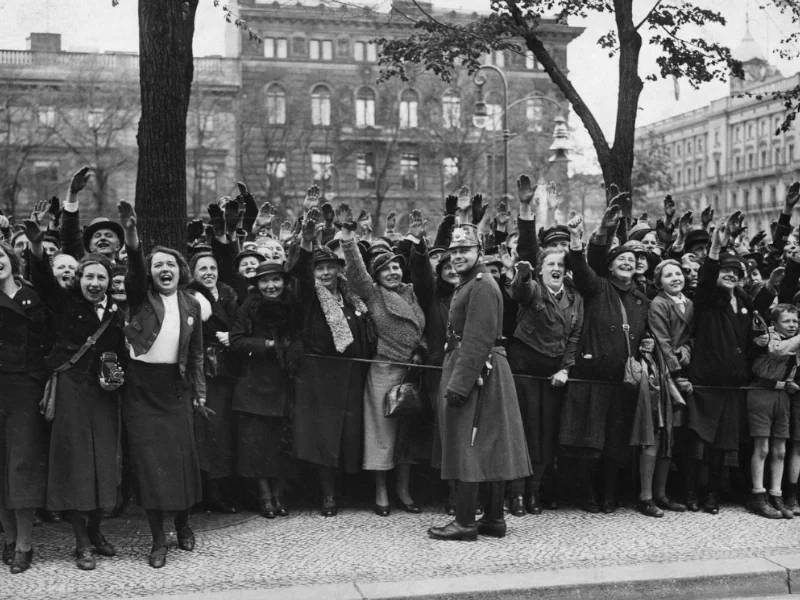
Following its establishment in Italy, fascist and fascist inspired movements emerged across numerous other European countries throughout the 1920s and 1930s, each adapting the core ideology to local political and cultural contexts. Germany’s National Socialist movement under Adolf Hitler, while distinct in several important respects from Italian fascism, shared core authoritarian and ultranationalist characteristics with the broader fascist movement sweeping across the continent.
As these ideas spread, different countries developed their own terminology and their own domestic fascist movements and sympathizer groups, often relatively small in scale compared to the dominant fascist parties in Italy and Germany, but present nonetheless within the broader European political landscape of the era.
Denmark’s Experience During This Period
In Denmark specifically, the term fascisterne came to refer to Danish individuals and organizations who supported fascist ideology during this era. Denmark maintained a relatively small domestic fascist movement compared to the mass parties seen in Italy and Germany, though fascist sympathizers and organizations did exist within Danish society during the 1930s.
Denmark’s experience during World War II itself was shaped significantly by the German occupation, which began in April 1940. Unlike some other occupied nations, Denmark initially maintained a degree of domestic political autonomy under German occupation for a period, though this arrangement eventually broke down as the war progressed, leading to increased direct German control and the growth of an active Danish resistance movement working against both the occupying force and domestic fascist collaborators.
This complex history, encompassing both a domestic fascist movement and the broader experience of German occupation, remains an important part of Denmark’s twentieth century political history, studied extensively both within Denmark and in broader European historical scholarship covering the rise and consequences of fascism across the continent.
Modern Usage of the Term
Beyond its strict historical application, the word fascisterne continues to appear in contemporary Danish political discourse, though its usage in modern contexts varies significantly in precision. In careful historical or academic writing, the term retains its specific meaning, referring to actual historical fascist movements, organizations, or individuals from the relevant historical period.
In everyday political conversation, however, the term is sometimes used more loosely as a rhetorical insult directed at political opponents, rather than as a precise historical or ideological label. This looser, more casual usage can blur the line between genuine historical accuracy and political exaggeration, making context particularly important when encountering the term in modern Danish discourse, whether in news coverage, political commentary, or everyday conversation.
Why Understanding This History Matters
Studying the history behind terms like fascisterne serves a purpose extending well beyond simple linguistic curiosity. Understanding how fascist ideology took root, spread across different national contexts, and ultimately contributed to the devastation of World War II offers important lessons about the warning signs of authoritarian movements and the fragility of democratic institutions under sufficient social and economic pressure.
This historical understanding remains relevant to ongoing discussions about political extremism, authoritarianism, and the protection of democratic norms in the present day. Recognizing the specific historical patterns associated with fascism’s rise, economic instability, nationalist rhetoric, the erosion of democratic checks and balances, provides valuable context for evaluating similar warning signs that may emerge in contemporary political movements, regardless of the specific country or era in question.
Final Thoughts
Fascisterne is the Danish word for “the fascists,” a term with roots tracing back through Danish and Italian linguistic history to the ancient Roman symbol of the fasces. Beyond its straightforward translation, the word carries the weight of a specific and consequential period in European history, encompassing the rise of fascist ideology in Italy, its spread across the continent, and Denmark’s own complicated experience with both domestic fascist sympathizers and German occupation during World War II. Understanding this history, and the careful distinction between its precise historical usage and its looser modern political application, offers valuable insight into one of the most significant and cautionary chapters in modern European political history.

